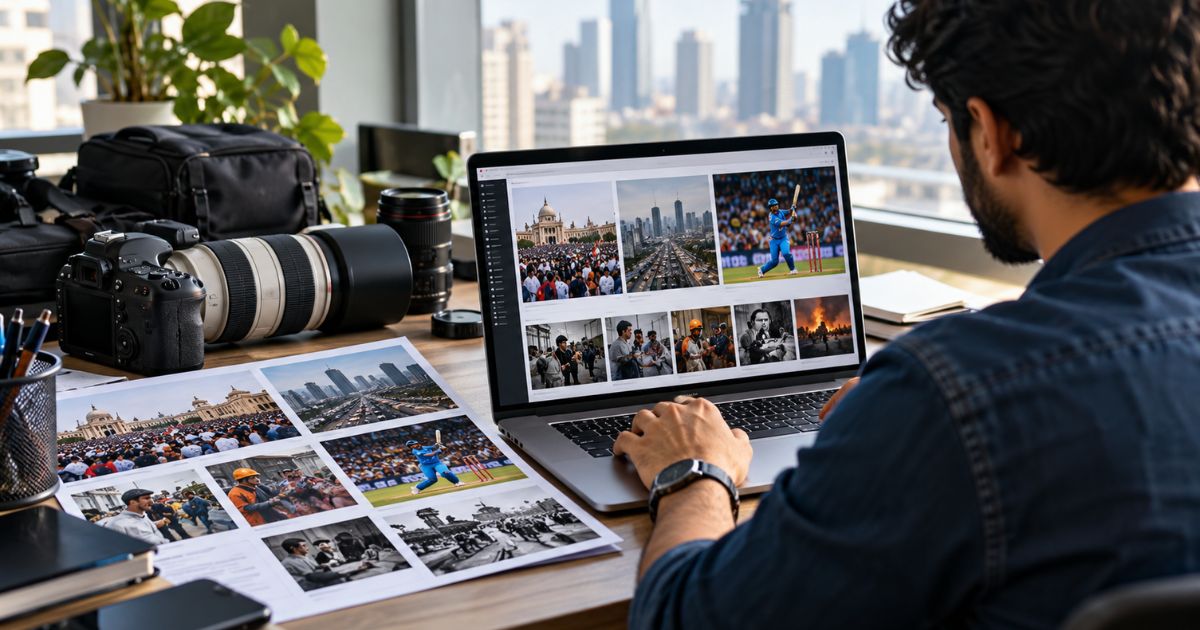
How to Sell News Photos Online: A Complete Guide for Photojournalists
 Admin
Admin- 14 Oct, 2026
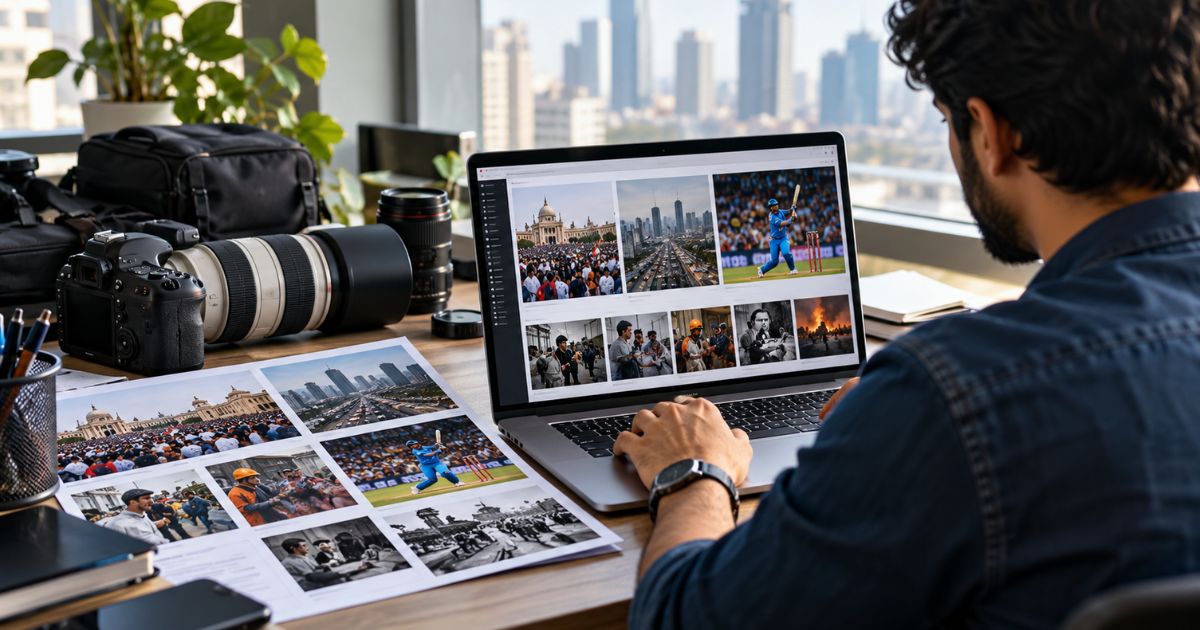
A powerful news photograph can communicate what hundreds of words cannot. It can document a historic event, reveal the human impact of a crisis, capture a decisive moment in sports, or bring an underreported community into the public eye.
For photojournalists, however, taking a compelling photograph is only part of the job. Finding the right buyer, reaching editors, negotiating usage rights, and earning fair compensation can be equally challenging.
Traditional routes, such as working for a newspaper, joining a photo agency, or pitching directly to editors, remain valuable. But online marketplaces have created additional ways for independent photographers to make their work available to media organizations.
If you are wondering how to sell news photos online, this guide explains how to prepare editorial photographs, make them discoverable to buyers, set appropriate prices, protect your rights, and use 5WH to connect your work with media houses.
What Does It Mean to Sell News Photos Online?
Selling news photos online generally means making photographs available to publishers, broadcasters, digital news platforms, magazines, and other eligible media buyers through a website, agency, or licensing marketplace.
Rather than relying entirely on personal contacts, a photographer can present images to a wider pool of potential buyers who need visuals for their reporting.
Depending on the platform and agreement, a transaction may involve:
- Editorial photo licensing: Giving a buyer permission to use a photograph for specified editorial purposes.
- Single-image sales: Offering an individual photograph for purchase.
- Photo gallery sales: Packaging several images from the same event or assignment.
- Breaking-news photography: Providing timely images of developing events.
- Assignment photography: Producing photographs in response to a media house's specific brief.
- Specialist photojournalism: Covering subjects such as politics, sports, business, culture, science, travel, or the environment.
The terms of a sale matter. Selling a photograph does not automatically mean transferring copyright or granting unlimited usage rights. The buyer's permitted use depends on the applicable license or contract.
For independent photojournalists, the opportunity is to combine strong visual reporting with an efficient way to reach potential buyers.
What Types of News Photos Can You Sell?
Media organizations need different kinds of images depending on their audience, publication schedule, and editorial coverage. Understanding what you photograph can help you present your portfolio more effectively.
Breaking-news and current-affairs photography
Images from elections, public demonstrations, natural disasters, major announcements, court proceedings, and other significant events can be valuable to newsrooms covering developing stories.
For breaking-news photographs, timing, accurate captions, location details, and verification are particularly important.
Local and community news photography
Local photographers often have an advantage: they are already close to events that national or international newsrooms may not be able to cover directly.
Potential subjects include community meetings, local government decisions, infrastructure projects, cultural events, public-interest stories, and regional developments.
A well-documented local story can be relevant to a regional newspaper or a publisher serving a much wider audience.
Sports photography
Sports photojournalists can cover professional competitions, local tournaments, school sports, athletics, and community events.
Action photographs are only one part of sports coverage. Images of celebrations, reactions, coaches, spectators, and the atmosphere surrounding an event can also help editors tell a complete story.
Always check event access restrictions and any applicable photography or licensing rules.
Politics and public affairs
Political rallies, election campaigns, legislative proceedings, public consultations, and official events can generate demand for timely editorial photography.
Accuracy is essential. Captions should identify people and locations correctly, and images must not be presented in a way that misrepresents what happened.
Business, technology, and industry
Business photojournalism can include company announcements, manufacturing, transport, technology demonstrations, economic developments, workplace reporting, and industry events.
Images that clearly document a newsworthy event may be useful to specialist publications as well as general newsrooms.
Human-interest, culture, and lifestyle
Photographs documenting everyday life, traditions, arts, public services, education, and community experiences can have a longer editorial shelf life than some breaking-news images.
These photographs may appeal to publishers looking for feature stories, explanatory reporting, or coverage of communities that receive limited attention.
Practical tip: Develop a recognizable area of expertise, but do not limit yourself to a single category if you have the skills and access to cover other subjects. A focused portfolio helps editors understand your strengths quickly.
How to Sell News Photos Online: Step-by-Step
Finding a buyer becomes easier when your photographs are professionally prepared, accurately described, and offered with clear usage terms.
Step 1: Select photographs with editorial value
Start by reviewing your strongest images. Technical quality matters, but a photograph must also communicate something relevant to a news audience.
Look for images that have:
- A clear subject and a meaningful moment.
- Accurate focus and suitable exposure.
- Strong composition without misleading manipulation.
- A clear connection to a verifiable event, person, or location.
- Editorial relevance, whether immediate or longer-term.
- Sufficient resolution for the intended publication.
For a breaking-news event, prioritize timeliness and factual accuracy. For a feature story, consider whether a sequence of images tells a more complete story than a single photograph.
Avoid uploading large numbers of near-identical frames. A carefully selected set is easier for editors to review.
Step 2: Write accurate captions and add metadata
A photograph without reliable information can be difficult for an editor to use, even when the image itself is excellent.
Prepare a caption that explains what the image shows and supplies the information a newsroom needs to assess it.
Where known and relevant, include:
- Who: Correctly identified people, with appropriate spellings and titles.
- What: The event or action taking place.
- When: The date and, when relevant, the time.
- Where: The specific location, city, and country.
- Why or context: The relevant background needed to understand the image.
The familiar journalistic questions—who, what, when, where, why, and how—are a useful framework for accurate photo captions.
For example:
“Residents attend a public meeting about proposed transport changes in [City, Country], on [date]. The meeting was organized by [organization], according to [verified source].”
Use this only as a template; replace the placeholders with verified information.
Add relevant keywords and metadata where the submission system supports them. Include names, event details, location, subject category, and other factual terms that help editors find the photograph.
Do not guess identities, dates, or locations. If a detail is uncertain, verify it or leave it out.
Step 3: Check copyright, permissions, and editorial ethics
Before offering a photograph for sale, confirm that you have the right to license it.
Ask yourself:
- Did I take the photograph, or do I have documented authorization to offer it?
- Does an employer, commissioning client, or agency own or control the relevant rights?
- Were there event accreditation terms or contractual restrictions?
- Does the photograph contain material that raises third-party rights concerns?
- Are model releases, property permissions, or other clearances necessary for the intended use?
The answers depend on the circumstances and jurisdiction. A photograph of a newsworthy event may be suitable for editorial use but not necessarily for advertising or promotional use.
Do not assume that appearing in public automatically resolves every privacy, access, or usage issue.
Editorial integrity is non-negotiable. Do not add, remove, or reposition important elements in a news photograph in ways that change its meaning. Ordinary technical adjustments should preserve the authenticity of the image and comply with the buyer's or platform's editorial standards.
AI-generated or materially AI-altered imagery should never be represented as authentic documentary photography. Follow the relevant platform's rules and disclose any permitted alterations where required.
Step 4: Choose where to sell your photographs
There are several routes for selling editorial photography. Each has different requirements, buyer relationships, commission structures, and levels of control.
Direct pitching to editors: You approach news organizations with a relevant photograph or portfolio. This can work well when you understand a publication's coverage needs, but it requires research, outreach, and follow-up.
Photo agencies: Agencies may distribute images to established buyers and handle aspects of licensing. Acceptance criteria, exclusivity, commissions, and contract terms vary by agency.
Stock photography platforms: Some platforms accept editorial images, although their definitions of editorial content and their contributor requirements differ. Read the rules carefully before submitting news photographs.
Online journalism marketplaces: These platforms connect content creators with media organizations looking for material. Depending on their features, they may let journalists list work, set prices, or offer content for buyer bids.
One option for professional journalists is 5WH, a multilingual e-commerce marketplace designed to connect journalists with media houses. Its journalist platform supports photo news stories and galleries, alongside text, audio, and video content. The platform describes options for setting a price or allowing media houses to bid on eligible submissions.
Learn more at the 5WH Journalist Marketplace.
Step 5: Prepare a professional journalist profile
A strong profile gives potential buyers context about the person behind the photograph.
Include the information requested by the platform and, where applicable, make sure your profile clearly communicates:
- Your name and professional identity.
- Your location and the areas you can cover.
- Your photography specializations.
- Languages in which you can report or communicate.
- Relevant reporting experience and credentials.
- Links to published work or a portfolio.
- Professional contact and availability information, where appropriate.
Be specific. An editor looking for a photographer who can cover local government in a particular city needs different information from an editor seeking an experienced sports photographer.
For journalists joining 5WH, the published onboarding process asks applicants for professional information and links to at least three examples of published, broadcast, or telecast work. Applicants should review the current requirements before beginning registration.
See the 5WH journalist onboarding guide.
Step 6: Upload photographs in the required format
Prepare files according to the marketplace's current technical requirements. Keep your original, high-quality files safely stored, and create upload versions that comply with the platform's specifications.
The 5WH FAQ lists JPG, JPEG, PNG, and TIFF as accepted photo formats. It also specifies an ideal resolution of 300 DPI and a maximum image size of 4 MB under its stated requirements. Because technical limits can change, verify the current upload instructions before preparing a large batch of photographs.
Remember that DPI alone does not determine image quality. Pixel dimensions, focus, compression, and the intended publication use all matter. Avoid unnecessary compression that introduces visible artifacts.
Use clear filenames that help you manage your work, such as:
city-event-date-subject-01.jpg
Avoid using vague names such as IMG_0024.jpg for your final organized files.
Step 7: Set a price and define the permitted use
Pricing editorial photography involves more than deciding how much time you spent taking a picture.
Consider:
- The importance and timeliness of the event.
- Whether the photograph is exclusive or available to multiple buyers.
- The buyer's intended use and audience.
- The image's uniqueness and editorial value.
- The effort and costs involved in producing the image.
- The license terms and the platform's applicable fees.
A breaking-news image with limited availability may be priced differently from a general feature photograph that can be licensed repeatedly.
On 5WH, journalists can use the platform's available content categories, which include Free, Shared, Exclusive, and Bid. The published FAQ explains that Shared content can have a purchase limit, Exclusive content is offered for purchase by a single media house, and Bid content uses an auction-style process.
Understand the conditions of each category before choosing one. Set a price that reflects the image's value and the permitted use, and review the platform's terms for how transactions and revenue are handled.
There is no universal price that guarantees a sale. Buyer demand, image quality, relevance, rights, and competition all influence commercial outcomes.
Step 8: Submit your photographs and make them discoverable
Once your profile is ready and your photographs meet the submission requirements, follow the platform's process for uploading and listing content.
Before publishing a listing, check that:
- The image and caption match.
- Names, dates, and locations are correct.
- Relevant keywords are included.
- Your rights and usage terms are clear.
- The price or bidding settings are accurate.
- Any required credit or attribution information is supplied.
- The content is categorized appropriately.
On 5WH, journalists can submit content through the platform and offer eligible work to media houses for purchase or bidding. The platform also provides tutorials covering journalist onboarding and story filing.
Visit the 5WH tutorials page for the available guidance.
Step 9: Review performance and improve your submissions
A listing that does not sell immediately does not necessarily mean the photograph lacks value. The image may not match current buyer needs, or the caption may not provide enough information for editors to find it.
Review your portfolio regularly.
- Improve captions and keywords where they are incomplete.
- Remove factual errors and correct metadata.
- Add new work when you cover relevant events.
- Develop a consistent portfolio in your strongest subject areas.
- Review pricing and usage terms for future submissions.
- Follow up on relevant assignments and opportunities through permitted platform channels.
Do not repost the same photograph repeatedly without a clear reason. Maintain accurate records of where each image is listed, which rights have been granted, and any exclusivity obligations.
How Much Can You Earn Selling News Photos Online?
There is no single reliable figure for how much a photojournalist can earn from online news photography. Income varies with the quality and relevance of the photographs, buyer demand, the photographer's experience, licensing terms, and the number of successful transactions.
A single image may sell once under an exclusive arrangement, or it may be offered to multiple buyers under a suitable non-exclusive license. These approaches have different revenue potential and restrictions.
To develop a sustainable photography business, consider the following:
Build a relevant portfolio. A focused collection of well-documented images can help demonstrate your expertise to buyers.
Prioritize timely coverage. For breaking news, accurate and prompt submissions can be important. Do not sacrifice verification or safety to upload first.
Diversify your subject areas. If your skills allow it, combine current-affairs coverage with sports, culture, business, community reporting, or other specialties.
Understand every fee. Check platform commissions, payment processing, taxes, currency conversion, and any applicable membership or registration charges before estimating your net income.
Track your results. Record submissions, sales, prices, licensing terms, and expenses. Use this information to identify which types of work are most commercially viable for you.
A marketplace can help make photographs available to buyers, but it cannot guarantee that every image will sell or produce a particular income.
How to Make Your News Photos More Attractive to Media Buyers
Editors often work under tight deadlines. They need to identify relevant photographs quickly and understand whether those images are accurate, usable, and properly documented.
The following practices can improve the professional quality of your submissions.
Lead with the strongest image
Select the photograph that communicates the event most clearly. Do not assume that the most dramatic image is always the most useful; context and factual accuracy matter.
Write captions for editors, not just viewers
A caption should provide verified facts, not simply describe what is visually obvious. Avoid unsupported interpretations and emotionally loaded language.
Use searchable keywords naturally
Relevant keywords might include the event, location, people, organization, subject, and date. Avoid keyword stuffing or adding terms unrelated to the photograph.
Offer context where it is needed
A short note explaining the event, the source of a key fact, or the sequence of images may help editors assess the material. Clearly distinguish verified information from claims that remain unconfirmed.
Maintain a consistent professional identity
Keep your portfolio, profile information, professional biography, and published credits consistent. A complete profile helps buyers understand your capabilities and assess your experience.
Deliver the right material promptly
If an editor needs a specific crop, additional frames, or a related sequence, follow the agreed delivery requirements. Keep originals available and ensure that any edited version remains within the permitted editorial standards.
Copyright and Licensing: What Every Photojournalist Should Know
Copyright and licensing are central to selling editorial photographs. A clear agreement protects both the photographer and the buyer by specifying what use is permitted.
Before accepting a sale, understand the difference between these concepts:
Copyright ownership: Who owns the underlying rights in the photograph.
License: The permission granted to a buyer to use the photograph under specified conditions.
Exclusive license: An arrangement that restricts licensing or use by others as defined in the contract. The exact scope and duration depend on the agreement.
Non-exclusive license: An arrangement that generally permits the photographer to license the same image to other buyers, subject to the contract.
Usage restrictions: Conditions governing the publication, territory, duration, attribution, or purpose of use.
Always read the actual agreement. Labels such as “exclusive” or “shared” can have platform-specific meanings, and the details of the applicable contract control.
For example, an image licensed for editorial reporting should not automatically be used in a commercial advertisement. If a buyer wants to use a news photograph for promotion, branding, or another purpose beyond the original license, additional permission may be necessary.
For more information about editorial licensing principles, review the Associated Press content license terms. These are AP's terms, not a substitute for reviewing the contract that governs your own photographs.
Common Mistakes to Avoid When Selling News Photography
Even technically strong photographs can be difficult to sell if the submission process is careless.
Uploading photographs without useful captions: Editors need accurate information to identify the event and assess the image.
Ignoring copyright or accreditation restrictions: Make sure you are entitled to offer the photograph and that your agreement allows the intended transaction.
Manipulating documentary images misleadingly: Changes that alter the factual meaning of a news photograph undermine editorial integrity.
Using inaccurate keywords: Misleading metadata can damage trust and make relevant photographs harder to discover.
Setting prices without considering usage rights: Exclusivity, distribution, and permitted use can affect a photograph's value.
Relying on one source of buyers: Direct pitching, agencies, assignments, and marketplaces can serve different purposes. Choose channels that fit your work and rights.
Neglecting your profile: A sparse profile makes it harder for an editor to assess your expertise and coverage capabilities.
Assuming that every upload will sell: Demand is variable. Treat photography sales as a business process that requires professional preparation, consistent output, and realistic expectations.
Why Consider 5WH for Selling News Photos Online?
For journalists who want to reach media houses beyond their immediate professional network, 5WH offers an online marketplace designed specifically for professional journalism content.
The platform brings together journalists and media organizations looking for material across multiple formats, including text, photographs, video, audio, and animation.
For photojournalists, the relevant features include:
- Content discovery: Make eligible photo stories and galleries available to registered media-house buyers.
- Pricing options: Set prices or use available bidding options where appropriate.
- Multiple content formats: Develop a broader portfolio that can include photography alongside reporting, audio, and video.
- Professional profile: Present your experience, interests, languages, and published work to the platform's community.
- Editorial review: 5WH describes a journalist vetting process and editorial quality controls.
These features can help structure the process of offering journalism to potential buyers. Actual sales depend on buyer demand, the quality and relevance of submissions, applicable terms, and other commercial factors.
Before joining, review the current registration requirements, fees, membership conditions, content policies, and payment terms.
Ready to put your photojournalism in front of media houses?
Register as a journalist on 5WH
Review the journalist onboarding process to prepare your professional details and work samples before applying.
Conclusion: Turn Your Photography into a Professional Opportunity
Great photojournalism combines visual storytelling with accuracy, context, timing, and trust. Selling news photos online requires the same professionalism beyond the camera: preparing strong images, writing reliable captions, understanding copyright, pricing appropriately, and making work discoverable to the right buyers.
For independent photojournalists, online marketplaces provide another route to reach media organizations without relying exclusively on personal contacts or traditional employment.
If you are ready to expand your reach, prepare your portfolio, review the relevant licensing terms, and explore platforms that connect journalists with media houses.
Your next photograph could tell a story that reaches far beyond the place where you captured it.
Explore the 5WH Journalist Marketplace and learn how to submit your work to media houses.
Frequently Asked Questions About Selling News Photos Online
Where can I sell news photos online?
You can explore direct licensing to publishers, editorial photo agencies, stock platforms that accept editorial images, and journalism marketplaces. Compare their acceptance requirements, fees, rights policies, and buyer access before choosing a channel. 5WH is one marketplace where registered journalists can offer eligible photo stories and galleries to media houses.
How do I sell photos to newspapers and digital news websites?
Prepare a relevant portfolio, write accurate captions, confirm your licensing rights, and identify the publications that cover your subject. You can pitch editors directly or use a suitable marketplace to make your work available to media buyers.
Can freelance photojournalists sell photographs without working for a newspaper?
Yes. Freelance photojournalists can pursue independent assignments and sell or license photographs, provided they have the necessary rights and comply with applicable contracts, access restrictions, and platform requirements.
What kinds of news photos are in demand?
Demand varies with current events and editorial priorities. Breaking news, politics, sports, local reporting, business, culture, and human-interest photography can all be relevant. No category guarantees sales; accurate documentation and relevance to a buyer's needs remain important.
How should I price a news photograph?
Consider the image's editorial value, timeliness, exclusivity, permitted usage, production costs, and applicable fees. Compare relevant licensing options and read the marketplace's pricing rules. There is no universal rate that applies to every news photograph.
Do I lose copyright when I sell a photograph?
Not necessarily. A sale may grant a license rather than transfer copyright, but the answer depends on the agreement. Read the contract carefully and confirm the rights you retain, the uses permitted, and any exclusivity restrictions.
What file format should I use for news photography?
Common formats include JPEG and TIFF, but accepted formats and file-size limits vary by platform. Follow the current submission requirements. The 5WH FAQ lists JPG, JPEG, PNG, and TIFF as accepted formats; check its latest instructions before uploading.
How can I make my photographs easier for editors to find?
Use accurate captions, relevant keywords, correct dates and locations, clear subject categories, and a complete professional profile. Avoid unsupported claims and misleading metadata.
Can I sell the same news photograph to multiple media houses?
That depends on the licensing arrangement and any exclusivity restrictions. A non-exclusive license may permit multiple sales, while an exclusive agreement may restrict other sales or uses. Review the terms before offering the image elsewhere.
Does uploading a photograph guarantee a sale?
No. Listing a photograph makes it available for potential discovery, but a sale depends on buyer interest, relevance, image quality, pricing, licensing terms, and market conditions.